You Don’t Have a Conversion Problem. You Have a Trust Sequence Problem (Part One)
The buyer who burned you was right to do it. Here’s how to earn belief before you have proof.

Issue #11 · May 2026 · Trust Architecture
Your AI product doesn’t convert because the buyer has already bought one like it.
Not because they’re wrong. Because they’re experienced. They greenlit a pilot six months ago. It ran three months. The demos were excellent. Production was not. Two people still babysit the tool. The ROI slide has a footnote. They are not skeptical of AI. They are skeptical of you. Another vendor. Same confident language as the last one.
That’s a credibility wound.
You can’t patch a credibility wound with a better demo.
What you need is a different sequence.
TRUST IS NOT A FEELING. IT’S AN ARCHITECTURE.
Every piece of content your company produces maps to one of three layers. Post. Case study. Demo. Thread. All of it. The layers only work in order.
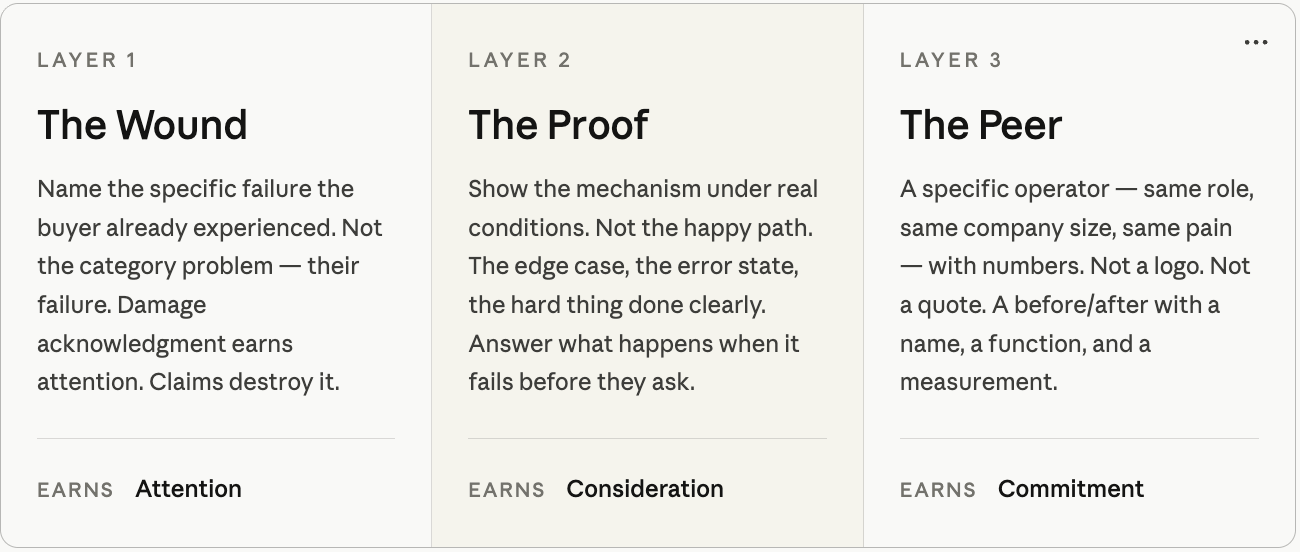
Diagram 1: The three-layer trust stack
A demo before the wound is named is a capability claim nobody believes yet. A case study before the proof is a testimonial nobody can verify. The peer witness without the proof underneath it is a logo on a page.
Wound earns attention. Proof earns consideration. Peer earns commitment. That order is not optional.
THE BUYER YOU KEEP WRITING FOR IS NOT THE BUYER STALLING YOUR PIPELINE.
You have three buyers simultaneously. They need different things. They convert on different signals. Write for one and you starve the other two.
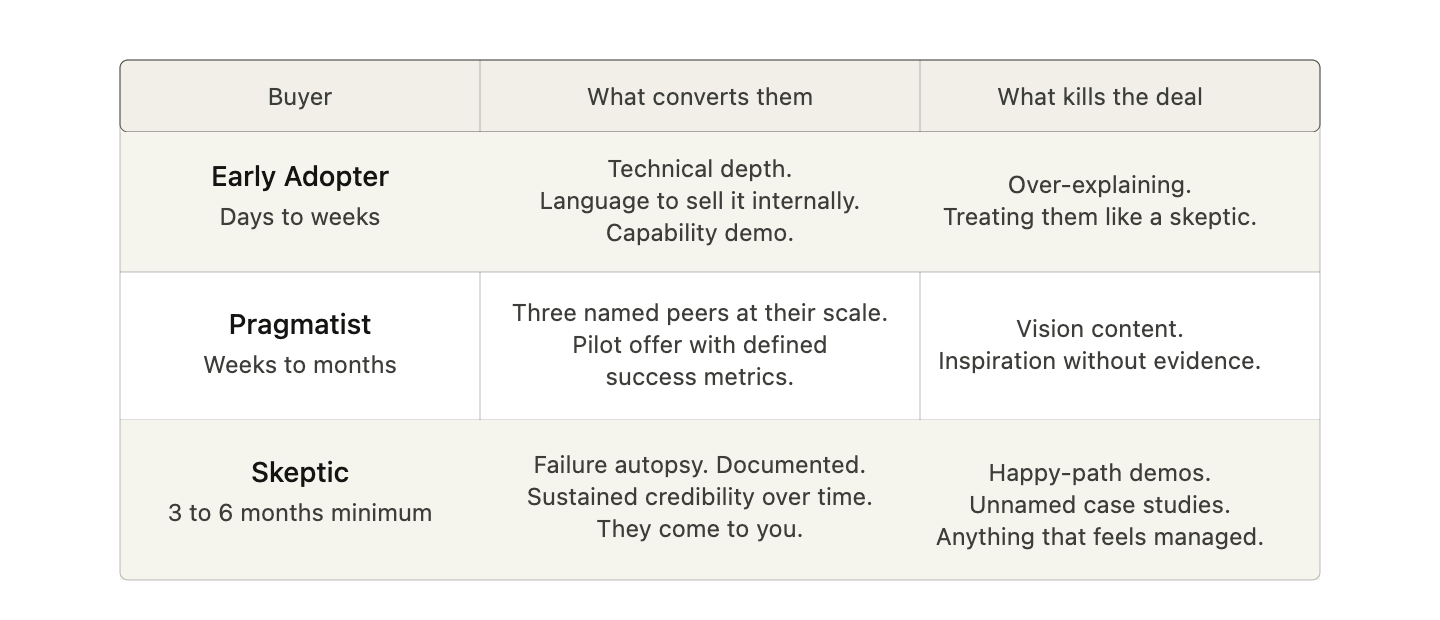
Diagram 2: The three buyer types
The early adopter converts in days. They already believe AI solves this. They need vocabulary to sell it internally, not a tutorial on why it matters. Give them technical depth and sharp language. Explain too much and they conclude you don’t know who you’re talking to.
The pragmatist converts in months. They are not skeptical of AI. They are skeptical of being first. They are waiting for the moment they can say “companies like ours are already doing this.” Three peer witnesses at their scale. That is their conversion trigger. Not a vision deck. Not an ROI calculator. Three named people who look like them, with numbers.
The skeptic converts in quarters, if you earned it. They will not engage with capability content until they trust your honesty. They will not trust your honesty until you have documented failure publicly. When they convert, they are your most loyal customer. They never get pitched. They come to you.
Most startups optimize for the early adopter. The numbers look good early. By month five the pipeline is hollow and nobody knows why. The pragmatist and skeptic pipelines were never built.
THE FORMAT SORTS THE BUYER. YOU DON’T HAVE TO.
You don’t need to know which buyer is reading. The format tells them.
A sharp take, one counterintuitive sentence about where AI fails, attracts the skeptic and the pragmatist. They read it and think: this vendor has shipped hard things and is honest about them.
A capability demo attracts the early adopter. They see the mechanism and immediately start drafting their internal justification email.
A failure autopsy, what broke and why and what changed, documented publicly, attracts the skeptic exclusively. The early adopter skims it as due diligence. The skeptic reads it three times and forwards it to the CTO.
Build the full mix. The format does the sorting.
THE FORMAT NOBODY PUBLISHES AND EVERYONE NEEDS.
The failure autopsy.
What failed. Under what conditions. The root cause. What changed. Public. Named. Specific.
Most startups refuse to publish this because it feels like ammunition for competitors. It does the opposite. A burned buyer reading a failure autopsy does not think: this product failed, I should avoid it. They think: this vendor has shipped things hard enough to produce real failures, they are honest about it, and they fixed it. That is a vendor I can trust in production.
The vendor with no public failures has never shipped anything difficult. The burned buyer knows this.
It is the signal they read when they search your company name and find nothing that went wrong.
NOT EVERY BUYER KNOWS THEY HAVE THE WOUND YET.
Same framework. Different entry points. Four scenarios every AI company will recognise.
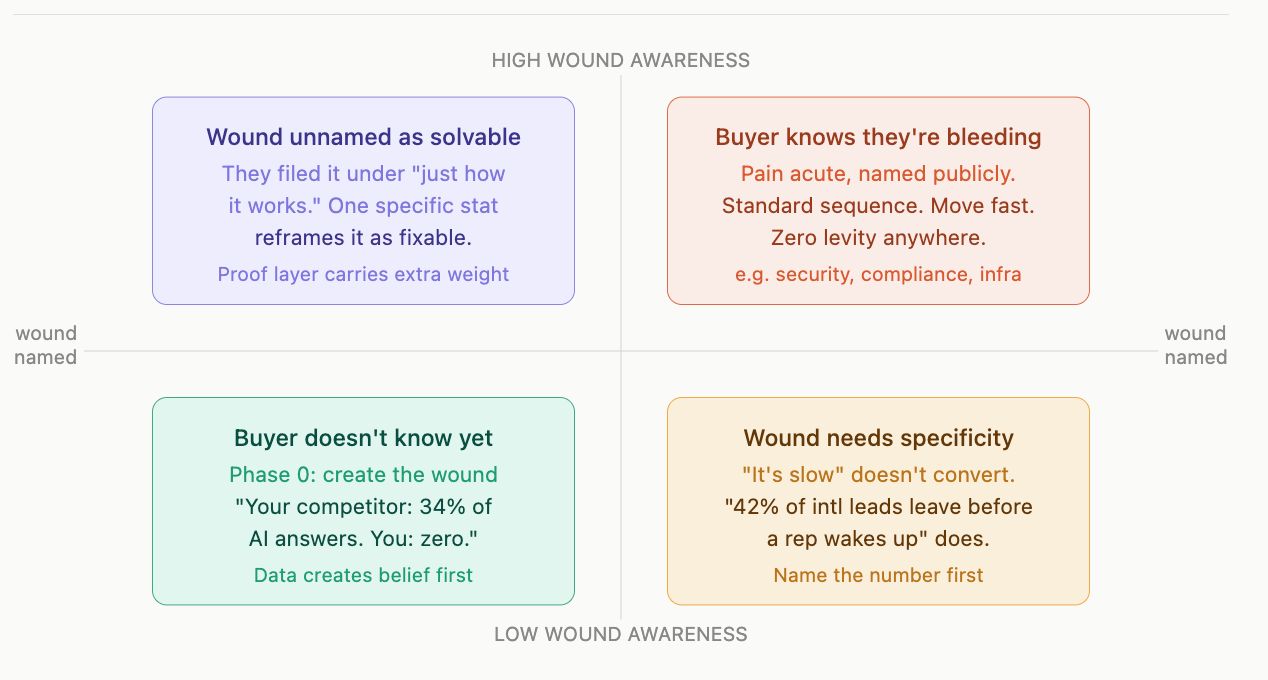
Diagram 3 — Wound awareness axis: four entry points
The buyer who knows they are bleeding. The pain is acute. The category failure is already named — in the press, in Slack, in the board meeting. Standard sequence. Move fast. No humour, no warmth, no lightness anywhere. Any tone that reads as casual reads as naivety about the stakes. Cybersecurity, compliance, and infrastructure all live here.
The buyer who has the wound but hasn’t named it as solvable. Something went wrong. A product was built on bad assumptions. A process failed. But the buyer has filed it under “that’s just how it works,” not “someone could fix this.” The proof layer carries extra weight here. A single specific stat — the kind that reframes the problem as solvable rather than inevitable — is the entire entry point. Without it front and centre, the skeptic does not advance.
The buyer who needs the wound made specific before they feel it. “It’s slow” does not convert. “42% of your international leads leave before a rep is awake to run the demo” does. The general frustration exists. The specific cost has never been calculated. Name the number. Make the wound financially legible before naming the solution.
The buyer who doesn’t know they have the wound yet. You cannot acknowledge a wound the buyer has not felt. Phase 0 comes first. Show them the data that creates the wound. “Your competitor appears in 34% of relevant AI-generated answers in your category. You appear in zero.” That sentence creates the wound. Then the sequence runs normally.
THE TRUST RUNWAY.
The B2B trust machine runs on a 6 to 9 month architecture. Not weeks.
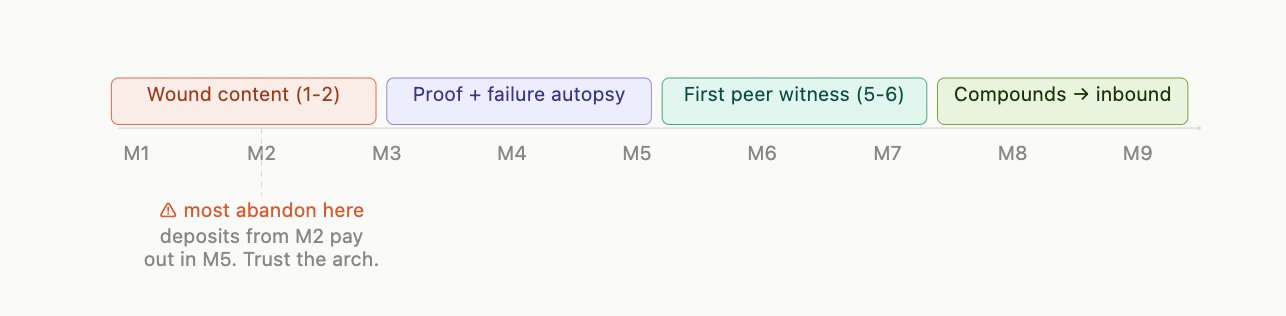
Diagram 4: The trust runway timeline
Nothing compounds until month four. Before that you are laying infrastructure. After that, inbound begins from buyers who have been watching since month one.
Month two is where most startups abandon the machine and revert to outbound. That reversion destroys the runway they were building. The deposits from month two pay out in month five. The skeptic who reaches out in month five does so because of what you published in month one. You will not see the connection in real time.
Trust the architecture.
THE PEER WITNESS. WHERE MOST STARTUPS DESTROY THE TRUST THEY ARE TRYING TO BUILD.
“A leading enterprise in financial services saw significant efficiency gains.”
That sentence is on a hundred websites. It does the opposite of what it intends. The burned buyer reads it and immediately reaches one of two conclusions: the company did not want to be named because the results were not impressive enough, or the vendor could not get permission because the relationship is weaker than implied.
Both interpretations are bad. Neither may be true. The unnamed case study is an active trust destroyer. If a customer cannot be named, the case study does not ship until they can.
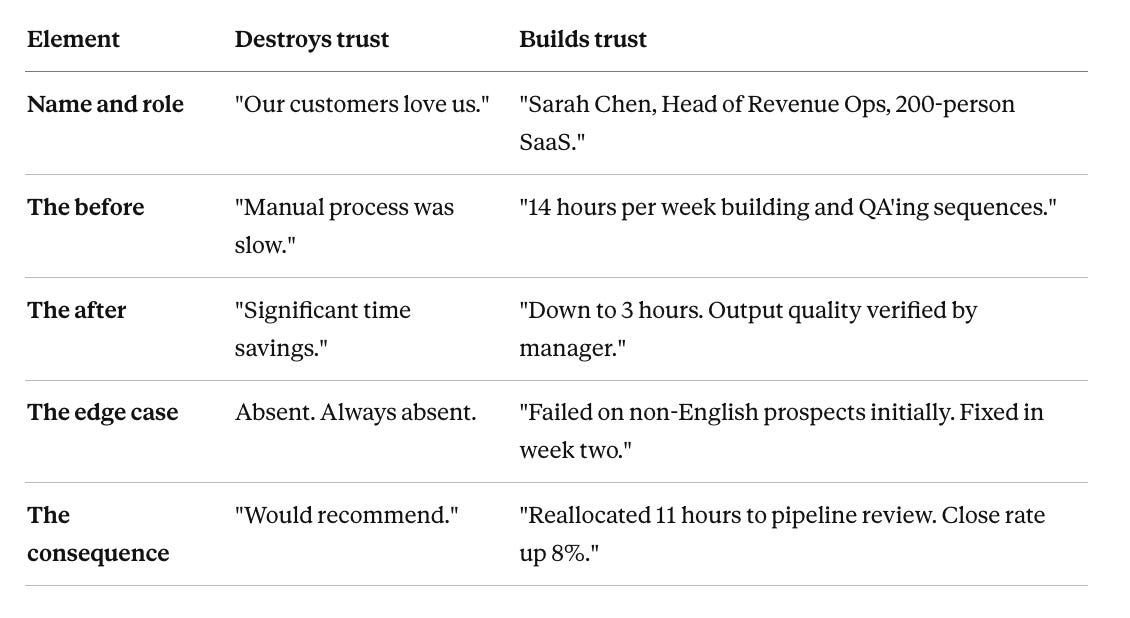
The edge case is the most important element and the one that is always missing. A case study with no failure moment signals that the product was never tested under real conditions, or that the narrative was managed. Include what went wrong. Make it specific. Show it was fixed. The edge case is not a liability. It is the proof that everything else in the case study is true.
One named peer witness with specific numbers outperforms ten unnamed ones. Not an opinion. What burned buyers consistently report when you ask them.
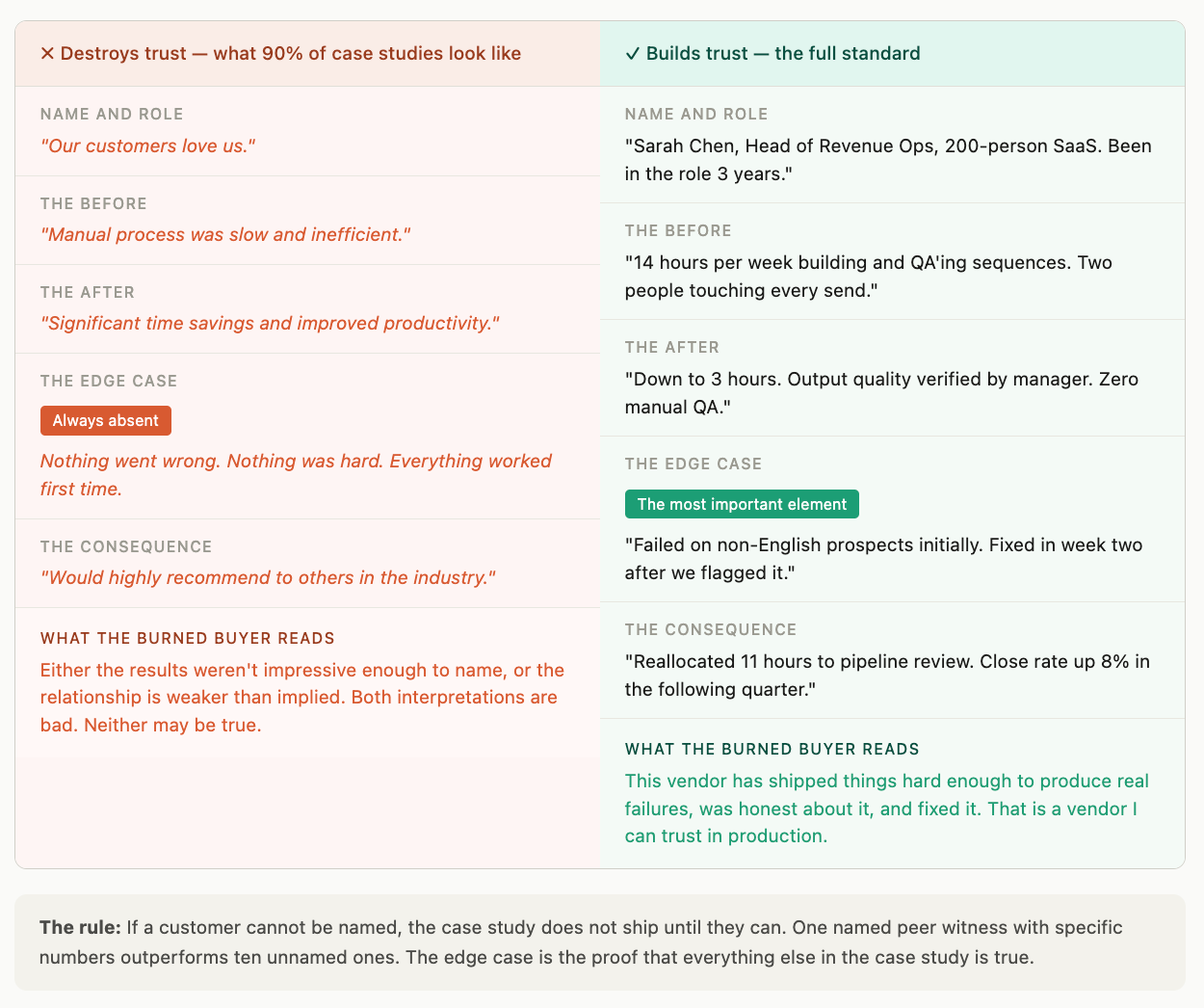
Diagram 6: Peer witness anatomy — destroys trust vs builds trust
THE 90 DAYS.
The sequence does not change regardless of which buyer type dominates your pipeline.
Days 1 to 30. Three to five pieces naming the specific failure precisely. No product content. No capability claims. You are earning the right to make a claim. Nothing else happens yet.
Days 31 to 60. Two to three pieces showing the mechanism under real conditions. Edge cases. Error states. The hard thing done clearly. One failure autopsy if you can ship it. The product earns the right to be mentioned.
Days 61 to 90. First peer witness. Full standard. Name, role, company context, specific before, specific after, something that went wrong, the consequence. This is the first conversion asset. Everything before this was infrastructure.
By day 90 the early adopter has enough to convert. The pragmatist has their first data point. The skeptic has enough signal to begin watching. The machine keeps running.
FOUR THINGS THAT DO NOT CHANGE REGARDLESS OF PRODUCT.
1. The specific wound. Not “AI implementations fail.” The exact failure your buyers have already experienced. The more specific it is, the more the burned buyer feels seen.
2. The mechanism under pressure. The hardest thing your product does, demonstrated under real conditions. The happy path is for investors. The hard case is for buyers.
3. The peer operator. Same role. Same company stage. Same pain history. Named. Willing to take a reference call. Everything else is a logo.
4. The banned vocabulary. Build the list. Enforce it before anything ships. “AI-powered.” “Seamless integration.” “Game-changing.” “Significant efficiency gains.” “A leading enterprise.” Every vague claim your category makes is an opportunity to be specific. Every unnamed case study is an opportunity to name yours.
The burned buyer does not need to be sold. They need to be shown that you are different from the last vendor who made the same promise.
Show them. Specifically. Consistently. Over time.
That is the only brief that matters.
Does the framework hold up against real companies? In Part Two, I ran the audit publicly on six AI startups — all founded in 2025. Click to move on.
UNDERCURRENT · What just changed? · Published weekly
Written by Alemsah Ozturk - Chief Storyteller, Disrupt. Based in Dubai.
Further Reading
MIT Project NANDA, The GenAI Divide: State of AI in Business 2025 (July 2025);
Pertama Partners, AI Project Failure Rate 2026 (February 2026); Edelman, Trust Barometer 2025 (2025);
Featherflow, The AI Startup Playbook: What’s Actually Working in 2026 (May 2026).